- Editorial:
- GUSTAVO GILI
- ISBN:
- 978-84-252-1959-7
- Páginas:
- 144
- Encuadernación:
- Rústica
- Colección:
- ARQUITECTURA
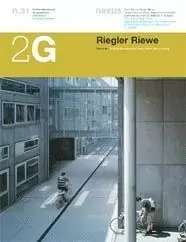
2G 31 RIEGLER RIEWE
Contents: Transportation Text by Eva Guttmann Education and Culture Text by Peter Allison Bigness. Becoming Sublime Text by Bart Lootsma TRANSPORTATION Central Railway Station and Südtiroler Platz, Innsbruck Travel centre for Österreichische Bundesbahnen (ÖBB- Austrian State Railways), Graz Airport, Graz Northern Railway Station, Vienna Enlargement of Terminal C, Frankfurt Airport, Frankfurt EDUCATION AND CULTURE Institutes for Computer Science and Electronics, Technische Universität, Graz Federal Institute for Social Pedagogy- BiSoP, Baden House of Literature, Graz Outline, MACBA, Barcelona Technical College- FOSBOS, Memmingen Multifunctional exhibition centre, Salzburg BIGNESS. BECOMING SUBLIME Trade Fair, Graz Urban scheme for the LUWA area, Zurich Urban scheme for the station area, Salzburg Football stadium, Cologne Extension to Trade Fair, Hamburg Biography nexus Roger Riewe Tetra Pak, or an Architecture of the Background Ernst Hubeli, Ullrich Schwarz Signatureless Architecture. Second Modernity A Conversation Between Ernst Hubeli and Ullrich Schwarz |
Associates since 1987, the Austrian architects Florian Riegler and Roger Riewe, with their professional practice in Graz and Cologne, tackle their projects in a subtle and practical way, renouncing formal authorship as the motor of the design process. Their buildings respond to the environment and to the cultural baggage of society without wishing to offer the spectator a stunning form with pre-existing symbolic meanings. Quite the opposite, in fact: Riegler Riewe?s buildings reveal themselves to be places in which the user has a highly active role in the definition and perception of the spaces.
This number of the magazine 2G demonstrates how their planning strategies enable them to readily tackle buildings of an ever-increasing size and complexity, from transport infrastructures such as the rail stations in Innsbruck and Vienna or the airports in Graz and Hamburg, taking in educational buildings like the Computer and Electronics Institutes of the University of Graz, complex residential projects and the football stadium in Cologne.